
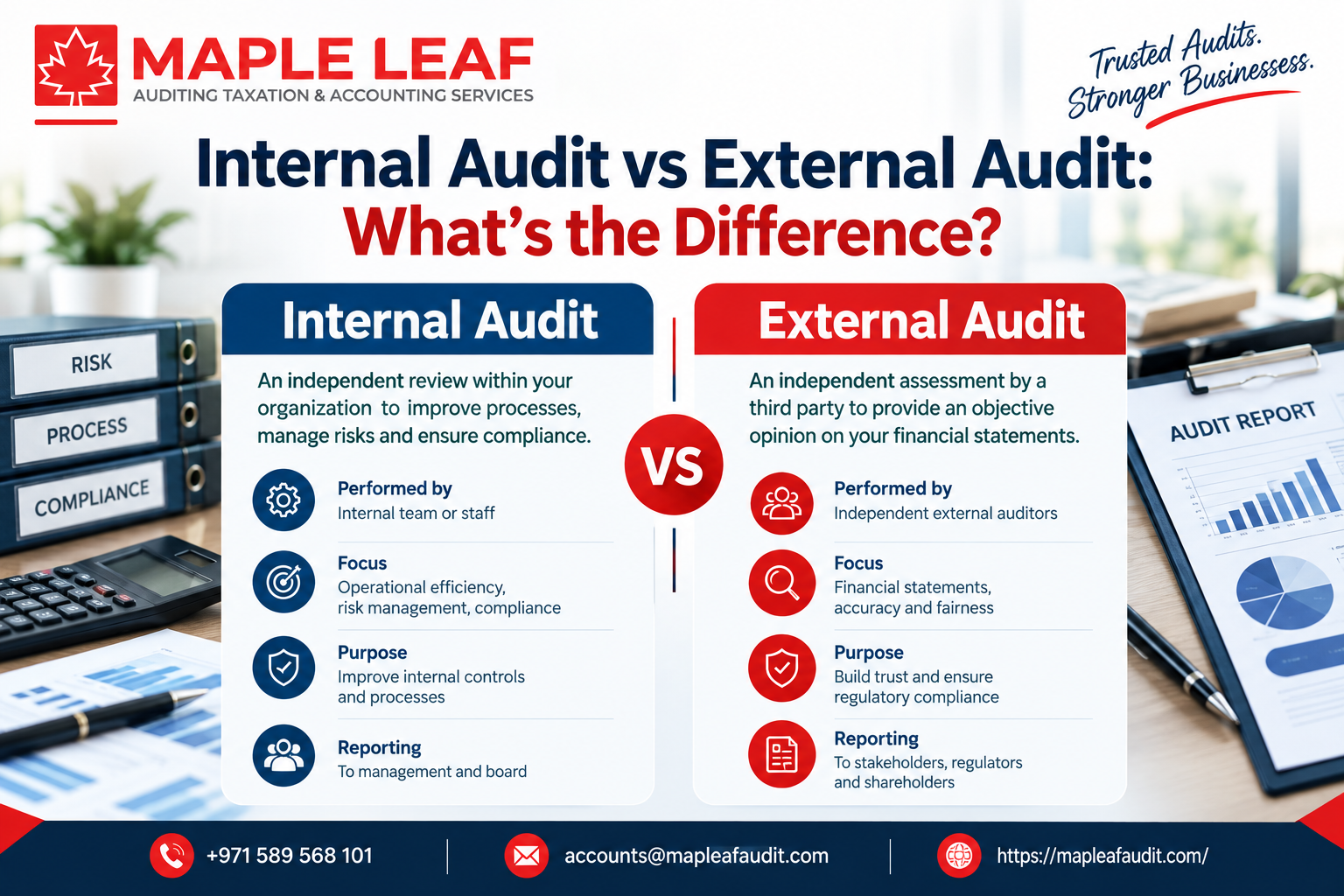
Internal Audit vs External Audit: What’s the Difference
As businesses grow, managing financial accuracy, operational efficiency, and regulatory compliance becomes increasingly important. One of the most effective ways to achieve these goals is through regular auditing. However, many business owners often ask: “What is the difference between an internal audit and an external audit?”
Although both types of audits involve reviewing a company’s financial and operational processes, they serve different purposes and provide unique benefits. Understanding when to use an internal audit, an external audit, or both can help businesses strengthen governance, reduce risks, improve financial reporting, and maintain compliance with applicable regulations.
What Is an Internal Audit?
An internal audit is an independent evaluation conducted within an organization to assess the effectiveness of its internal controls, operational processes, risk management practices, and compliance procedures.
The primary objective of an internal audit is to help management improve business performance rather than simply verify financial statements.
Internal auditors examine areas such as:
- Financial processes
- Internal controls
- Risk management
- Operational efficiency
- Regulatory compliance
- Information technology controls
- Inventory management
- Procurement procedures
- Corporate governance
Unlike external audits, internal audits are often performed throughout the year as part of an ongoing improvement process.
What Is an External Audit?
An external audit is an independent examination of a company’s financial statements conducted by a qualified external audit firm.
The purpose is to determine whether the financial statements present a true and fair view of the company’s financial position in accordance with applicable accounting standards and regulations.
External auditors focus primarily on:
- Financial statements
- Accounting records
- Supporting documentation
- Compliance with accounting standards
- Financial reporting accuracy
Their findings are presented in an official audit report, which may be shared with shareholders, investors, banks, and regulatory authorities.
Internal Audit vs External Audit: Key Differences
| Feature | Internal Audit | External Audit |
| Purpose | Improve operations and internal controls | Verify financial statements |
| Conducted By | Internal auditors or outsourced internal audit specialists | Independent external audit firm |
| Reporting To | Management and Board of Directors | Shareholders, regulators, lenders, and stakeholders |
| Frequency | Ongoing or periodic | Usually annually |
| Main Focus | Risk management, compliance, efficiency | Financial reporting accuracy |
| Mandatory | Generally optional (depending on business needs) | Often required by law or stakeholders |
| Scope | Broad operational review | Financial statement review |
| Objective | Improve business performance | Provide independent assurance |
Although they differ in scope and purpose, both audits complement each other and contribute to stronger business governance.
Objectives of an Internal Audit
Internal audits help organizations identify weaknesses before they become major problems.
Common objectives include:
- Improving operational efficiency
- Strengthening internal controls
- Identifying financial risks
- Preventing fraud
- Ensuring policy compliance
- Evaluating business processes
- Supporting strategic decision-making
- Reducing unnecessary costs
Internal audits provide management with valuable recommendations for continuous improvement.
Objectives of an External Audit
External audits focus on providing confidence to external stakeholders.
Key objectives include:
- Verifying financial statement accuracy
- Confirming compliance with accounting standards
- Supporting investor confidence
- Meeting statutory requirements
- Increasing financial transparency
- Detecting material misstatements
- Strengthening business credibility
An external audit provides independent assurance that financial reports can be trusted.
Benefits of Internal Audits
Internal audits offer numerous operational advantages.
1. Improves Risk Management
Every business faces financial, operational, legal, and cybersecurity risks.
Internal auditors assess these risks and recommend practical solutions to reduce exposure.
2. Enhances Operational Efficiency
Internal audits often identify:
- Duplicate processes
- Inefficient workflows
- Resource wastage
- Delays in approvals
Improving these areas can increase productivity while reducing costs.
3. Strengthens Internal Controls
Strong internal controls protect company assets and reduce the likelihood of fraud.
Internal auditors evaluate:
- Approval processes
- Financial authorizations
- Cash management
- Inventory controls
- IT security procedures
4. Supports Regulatory Compliance
Businesses operating in Dubai must comply with various accounting, VAT, and corporate tax regulations.
Internal audits help ensure ongoing compliance and reduce regulatory risks.
Benefits of External Audits
External audits provide confidence to people outside the organization.
1. Builds Investor Confidence
Investors rely on audited financial statements when making investment decisions.
An independent audit demonstrates transparency and accountability.
2. Improves Access to Financing
Banks often request audited financial statements before approving:
- Business loans
- Credit facilities
- Investment funding
Reliable financial reporting improves your credibility with lenders.
3. Supports Business Growth
As businesses expand, audited financial statements become increasingly valuable when:
- Entering new markets
- Attracting investors
- Forming partnerships
- Acquiring other businesses
4. Enhances Corporate Reputation
Independent audits demonstrate that your business follows professional accounting standards and maintains strong financial governance.
When Does a Business Need an Internal Audit?
An internal audit is particularly valuable when:
- Business operations are expanding.
- Multiple departments are involved.
- Fraud prevention is a priority.
- Internal controls need improvement.
- Regulatory compliance is becoming more complex.
- Management wants operational improvements.
Many growing SMEs in Dubai conduct regular internal audits to improve efficiency and prepare for future expansion.
When Does a Business Need an External Audit?
An external audit may be required when:
- It is legally required.
- Investors request audited financial statements.
- Banks require audited reports.
- The company is seeking financing.
- The business is preparing for acquisition or sale.
- Shareholders require independent assurance.
Annual external audits are considered best practice for many organizations.
Can Businesses Benefit from Both?
Absolutely.
Rather than choosing one over the other, many successful businesses use both internal and external audits.
For example:
- Internal audits improve daily operations.
- External audits verify financial reporting.
- Internal audits strengthen controls before external audits begin.
- Together they reduce financial risks and improve corporate governance.
Using both types of audits provides a more complete approach to financial management.
Common Misconceptions About Audits
“Internal and external audits are the same.”
Although they use similar auditing techniques, their objectives, reporting structures, and scope are very different.
“Only large companies need audits.”
Businesses of all sizes benefit from stronger financial controls, accurate reporting, and improved risk management.
“Audits only identify problems.”
Professional audits also identify opportunities for growth, efficiency improvements, and stronger financial management.
“Audits are stressful.”
With organized records and experienced auditors, audits can be completed efficiently with minimal disruption.
Best Practices for Successful Audits
To make both internal and external audits more effective:
- Maintain accurate accounting records.
- Reconcile accounts regularly.
- Keep supporting documents organised.
- Review internal policies periodically.
- Train employees on financial procedures.
- Strengthen approval processes.
- Monitor compliance with regulations.
- Address previous audit recommendations promptly.
Preparation helps ensure a smoother audit process and better outcomes.
Why Choose Maple Leaf Auditing Taxation and Accounting Services?
Selecting the right audit partner is essential for maintaining financial integrity and supporting long-term business success. Maple Leaf Auditing Taxation and Accounting Services, based in Dubai, United Arab Emirates, provides professional internal audit, external audit, accounting, taxation, compliance, and business advisory services tailored to businesses across multiple industries.
Businesses choose Maple Leaf Auditing Taxation and Accounting Services because of its:
- Experienced audit professionals
- Deep understanding of UAE regulations
- Industry-specific expertise
- Risk-based audit approach
- Commitment to financial transparency
- Tailored solutions for SMEs and large enterprises
Whether you require an internal audit to strengthen operational efficiency or an external audit to meet statutory and stakeholder requirements, Maple Leaf Auditing Taxation and Accounting Services delivers reliable, professional support to help your business thrive.
Conclusion
Understanding the difference between internal audits and external audits is essential for building a financially strong and well-governed business. While internal audits focus on improving processes, managing risks, and enhancing operational performance, external audits provide independent assurance that financial statements are accurate and comply with applicable standards.
Together, these audits strengthen transparency, improve decision-making, reduce financial risks, and increase confidence among investors, lenders, and regulatory authorities. For businesses in Dubai, United Arab Emirates, partnering with an experienced audit firm can make a significant difference in achieving long-term compliance and sustainable growth.
Maple Leaf Auditing Taxation and Accounting Services offers comprehensive internal audit, external audit, accounting, taxation, and advisory services to help businesses improve governance, maintain compliance, and achieve lasting financial success.
Frequently Asked Questions
An internal audit focuses on improving business operations, internal controls, and risk management, while an external audit independently verifies the accuracy of a company’s financial statements.
Not always. While some regulated industries may require internal audits, many businesses conduct them voluntarily to improve efficiency, strengthen governance, and manage risks.
External audits are carried out by independent, qualified audit firms that are not involved in the company’s daily operations, ensuring an objective review of financial statements.
Yes. Many organisations benefit from both. Internal audits support ongoing operational improvements, while external audits provide independent assurance to investors, lenders, and regulators.
Audits help businesses in Dubai maintain accurate financial records, improve compliance with UAE regulations, build stakeholder confidence, and support sustainable business growth.
